Interactive Kiosk Market: Historical, Current, And Projected Size Of The Market 2019 - 2027
According to a new market report published by Transparency Market Research titled ‘Interactive Kiosk Market (Type: Floor Standing, Wall Mount, and Others; End-use Industry: Retail & Hospitality, Financial Services, Healthcare, Media, Communication & Entertainment, and Government) – Global Industry Analysis, Size, Share, Growth, Trends, and Forecast, 2019–2027, the global interactive kiosk market is expected to reach US$ 43,697.0 Mn by 2027, expanding at a CAGR of 6.1% from 2019 to 2027. In terms of volume, the global interactive kiosk market is expected to reach 8,140.6 ‘000 units by 2027, expanding at a CAGR of 5.8%. Based on region, the global market has been segmented into North America, Europe, Asia Pacific, Middle East & Africa (MEA), and South America.
The interactive kiosk market in North America is mature and is the second-largest market globally. North America witnesses a significantly high number of non-cash transactions and this number is increasing owing to a surge in the use of interactive kiosks and ATMs.
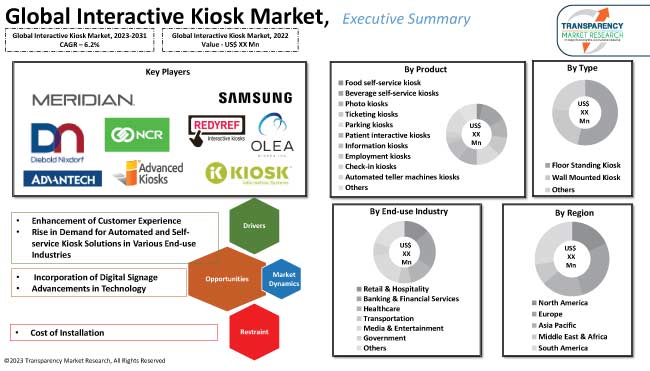
Europe is the third-largest market for interactive kiosk, globally, and it is a mature market. Europe follows North America, in terms of number of non-cash transactions, globally. In Europe, the U.K., Germany, and France are prominent markets for interactive kiosks. The baking industry is mature in Europe, and ATMs are a major banking channel. Rise in card payment and mobile commerce is driving the demand for interactive kiosks.
China is a prominent market for interactive kiosk in Asia Pacific, followed by Japan and India. In terms of ATM volume, China is a major market and accounts for more than 75.0% share of the global ATM market. India is also a prominent interactive kiosk market and demand for ATMs is increasing in India. In both China and India, rise in millennial population, increase in penetration of digital technologies, and government initiatives for financial inclusion are boosting the number of banking consumers.
Comments
Post a Comment