Smart Thermostat Market: Influential Factors Determining the Trajectory of the Market 2018-2026
The competitive landscape of the global smart thermostat market is consolidated and competitive with a limited number of companies operating in the market. Key players in the smart thermostat market are focusing on advanced technology to concretize their market position, says Transparency Market Research. Increasing demand for smart thermostat applications in commercial and residential sectors is expected to encourage investors to invest in smart thermostat technology.
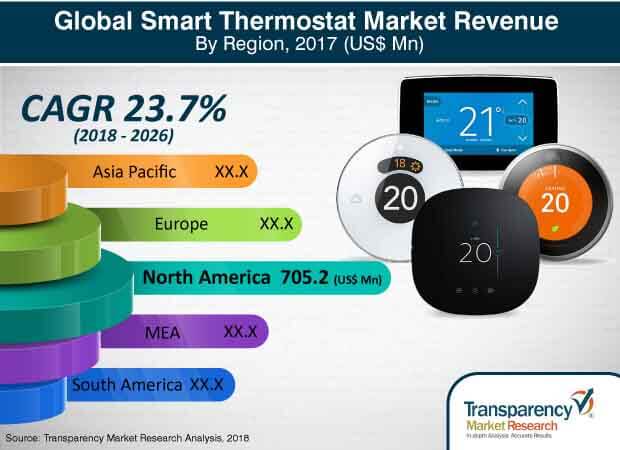
According to a new report by TMR, the smart thermostat market is expected to reach US$8,729.2 mn by 2026. The market is anticipated to grow at an astonishing 23.7% CAGR from 2018 to 2026.
On the basis of demand, Asia Pacific is projected to lead the global market during the forecast period. This is mainly because of the rising demand from countries such as China, India, Japan, and South Korea. Based on application, the residential segment is expected to account for a major market share in the forecast period. The segment anticipated to expand at a CAGR of 24.1% during the forecast period.
Need to Optimize Electricity Consumption to Augment Growth
The global smart thermostat market is likely to witness considerable growth in the upcoming years. This is mainly because of the rising demand for smart thermostat in residential and commercial sectors. Smart thermostat automatically achieves the required temperature changes for users, thus helps save energy. Prevailing energy crisis and growing need to optimize electricity consumption are the two key driving factors in the global smart thermostat market.
Along with this, supportive government initiatives to adopt energy saving equipment and growing awareness regarding the benefits offered by thermostat are anticipated to fuel the global thermostat market in coming years.
Comments
Post a Comment